When the Tool Disappears and No One Will Take the Job: PT1
Getting Apps Across the Finish Line
April 6, 2026
Time to read:
Time to read quantity


A high-volume book reselling operation faced an existential problem: the software they depended on to run their entire business was shutting down. Every day, their team scanned thousands of books, pulled metadata from Amazon and other sources, applied complex rules to decide what to keep and what to reject, priced inventory across multiple marketplaces, managed orders, and coordinated shipping — all through a single legacy platform that was about to go dark.
The next best option on the market was built on aging code with well-documented limitations. Even its seasoned development team was struggling to modernize the architecture to meet the demands of this vertical.
The client needed a full replacement — and they needed it before the clock ran out.
They contacted four development agencies and independent contractors. Every one of them either declined the project or couldn't get past the initial scoping phase.
From the outside, book reselling looks simple. It isn't.
Behind a single scanned book is a cascade of logic: real-time metadata retrieval from Amazon, priority-based acceptance rules that account for condition, sales rank, and category, automated pricing that adjusts based on time on market and competitive positioning, simultaneous listing across Amazon, eBay, Alibris, AbeBooks, Biblio, and other marketplaces, shipping integration, and full inventory and order tracking. Each of those systems has to talk to the others, and the rules governing them have to be configurable by non-technical users.
The agencies saw the complexity and made the rational decision — for them. They passed.
The problem wasn't that the technology was impossible. It was that no one had bridged the gap between what the business actually needed and how to architect a system to deliver it.
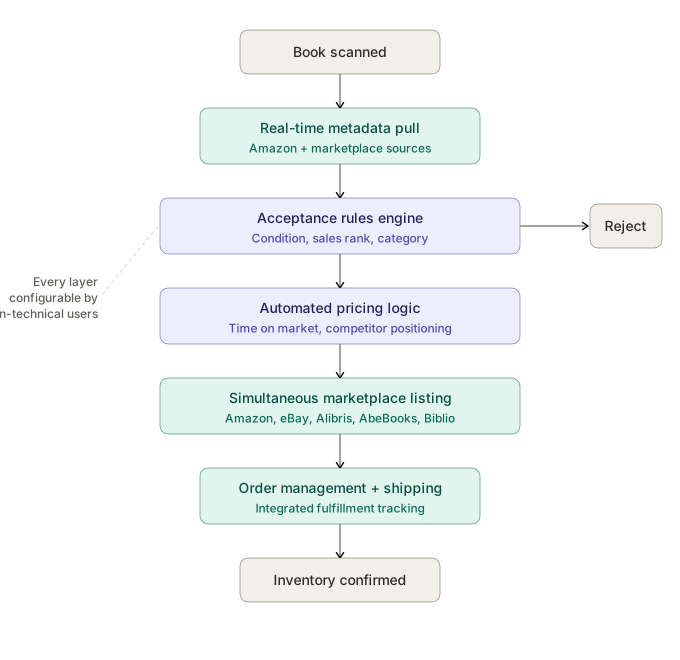
Most development teams approach a project like this as a feature list: scan a book, pull data, list it, track it. But the real challenge was the decision logic underneath — the layered, priority-based rules that govern every step from scan to sale. Getting that architecture wrong doesn't just create bugs. It creates a system the business can't trust, which means they can't use it, which means the project fails regardless of how clean the code is.
We started by understanding the business operation deeply — not the feature requests, but the actual workflow, the edge cases, the decisions being made by humans that the software needed to replicate. That understanding shaped an architecture that could handle the complexity without becoming brittle.
We built on Supabase and FlutterFlow, though the depth of the requirements meant most of the application is custom code. FlutterFlow's standard components couldn't support the logic this business demanded — which is precisely the kind of gap that trips up teams who lead with tools instead of architecture.
Security was non-negotiable from day one. In a system handling real-time marketplace data, pricing logic, and order management, a vulnerability doesn't just risk data — it risks the business.
Four months from a blank page, the first phase of the application is live and in daily use — built from scratch by a small team while the industry's established competitor, backed by seasoned developers, is still working to modernize their own platform. Scan speed matches the legacy system, but the accuracy and quality of listings has improved dramatically. Inventory that previously required manual review and correction now flows through the system with confidence.
Beyond the core scanning and listing workflow, we built research tools for managers and specialist staff that didn't exist in any previous solution — giving the operation visibility into their business that they'd never had before.
The second phase, completing the full feature set, ships in May 2026.
"To say it's a night and day difference would be an understatement. This is actually the tool I was trying to get someone to build for me years ago."— A., Founder
This story follows a pattern we see repeatedly: a business with a real, complex operational need reaches out to multiple development teams. Those teams either underestimate the complexity, can't translate the business requirements into working architecture, or simply decline because the risk-to-reward ratio doesn't fit their model.
The projects that fail aren't failing because of bad technology. They're failing because no one is bridging the gap between what the business needs and what the development team builds. That translation layer — part product strategy, part technical architecture, part honest communication — is what we do.
If your technology project has stalled, gone over budget, or been abandoned by a previous team, we can help. Contact Us →